
Training hard is supposed to make your body stronger, not tighter and more restricted. I see this pattern constantly with the runners, lifters, and bodybuilders who come through my Dunbar studio: the training is going well, but something in the fascia is holding them back from lifting, running, or moving the way they want to.
What myofascial release actually does
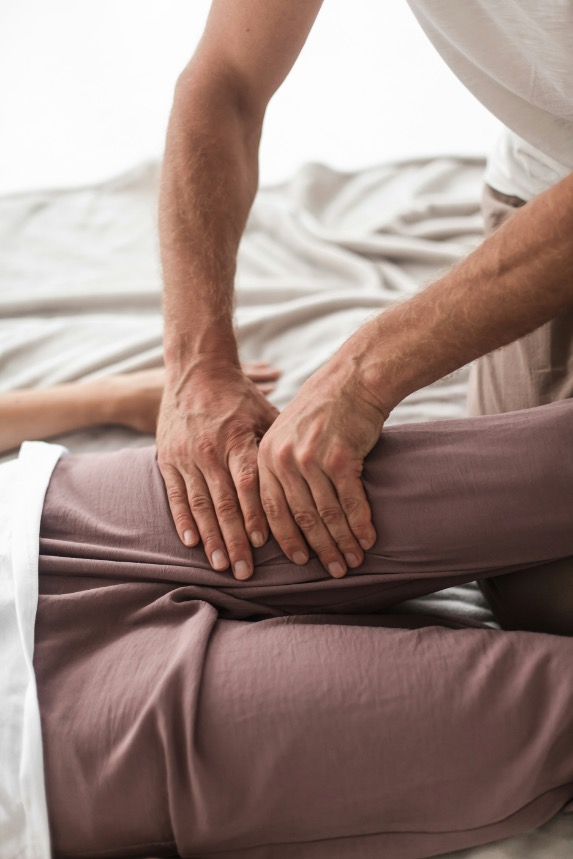
Fascia is the connective tissue that wraps every muscle in your body. When it gets tight or stuck, it pulls on everything around it, even areas that feel fine on their own. Myofascial release is slow, sustained pressure that works that tissue loose so the muscle underneath can move freely again. It is not a quick rubdown, it takes patience, and it takes knowing where to actually put my hands.
Runners: releasing the IT band
The IT band runs along the outside of the thigh from the hip to just below the knee, and it is one of the most common trouble spots I see in runners around Connellsville and Uniontown. When it tightens up, it pulls on the knee and can turn into the sharp outer-knee pain that sidelines a training block. I work the fascia along the whole length of the band, along with the hip muscles that feed into it, so the relief holds past the drive home instead of coming back at mile four.
Lifters and bodybuilders: the psoas
The psoas is a deep hip flexor that connects your spine to your leg, and it takes a beating from heavy squats, deadlifts, and hip-dominant lifts. When it stays short and tight, it limits how far your hip can extend and often shows up as low back tension that will not quit no matter how much you stretch. Working the psoas takes a slow, careful hand since it sits deep in the abdomen, but releasing it is often the piece that gets a lifter back to full range under the bar.
What to expect in a session
Every session starts with a real conversation: what you are training for, where it hurts, and what you have already tried. You stay in control of the pressure the whole time, and we adjust as we go. Myofascial work can feel intense in the moment on a tight spot, but it should never be sharp or shooting. If you are dealing with sharp, shooting, or numbness-type pain, that is worth a conversation with a doctor or physical therapist alongside the bodywork, not instead of it.
Getting you back to training, not just relaxed
Athletic bodywork is different from a relaxation massage. I want to know what you are training for and what movements feel restricted before I start working. Most athletes do well with a 90-minute Holistic Balance session, which gives enough time to work multiple areas with real depth, sometimes with Theragun percussion therapy layered in to speed things along.
Why athletes trust this work
I have been doing this for six-plus years and thousands of sessions, and the athletes I work with are a big part of that experience. You can read more about my background and approach here, but the short version is that I treat the cause, not just the sore spot, so the progress actually holds between sessions.
Serving Dunbar, Uniontown, and Connellsville
My studio is at 74 Connellsville St. in Dunbar, PA, and I regularly work with athletes from Uniontown and Connellsville as well as the wider Laurel Highlands. If you are training hard and your body is starting to fight you on it, let’s find the actual source of the restriction. Book a session and let’s get you back to full range.